Let me tell you how most people get into Phish, because it’s almost never through the studio albums. You go to a show with a friend, or somebody hands you a recording of a specific night, or you find a two-hour set on archive.org and you can’t figure out what you’re listening to (it doesn’t sound like anything you’ve heard before), and three hours later you’re still listening. That’s the Phish entry point, and it’s why Phish history is best understood through the shows, not the records. The studio albums come later, if at all. That’s not a criticism. It’s just how this band works.
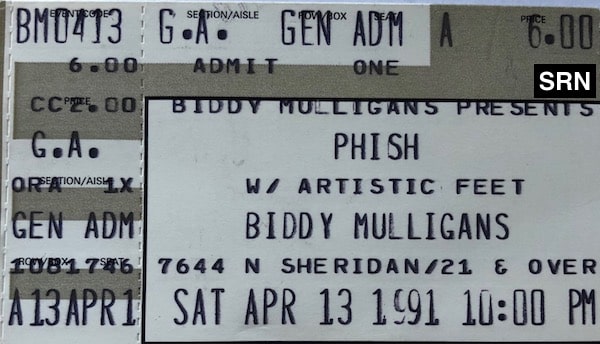
That’s how it happened to me, a good friend kept telling me about this great band from New England. I missed their first trip to Chicago, then finally caught them in the spring of 1991 at Biddy Mulligan’s, a small performance venue on the far north side of town with a capacity of 400 people. It’s a good thing the fire marshal wasn’t there, because it was overfilled with nearly five hundred fans in attendance. Biddy Mulligan’s was a great venue, but it has been long shuttered. After seeing Phish in a club that small, I’ve never been to one of their arena shows. It could never equal the intimacy of seeing them up close.
I’ve been covering the jam scene at InternetFM for years, and Phish sits at the center of every conversation about what live music can be. They’re not the easiest band to write about, because the thing that makes them remarkable (the improvisational language they’ve developed over four decades of playing together) doesn’t translate well to description. You have to hear it. But let me try to give you the Phish history that makes the hearing make sense.
Burlington, Vermont: Where Phish History Begins
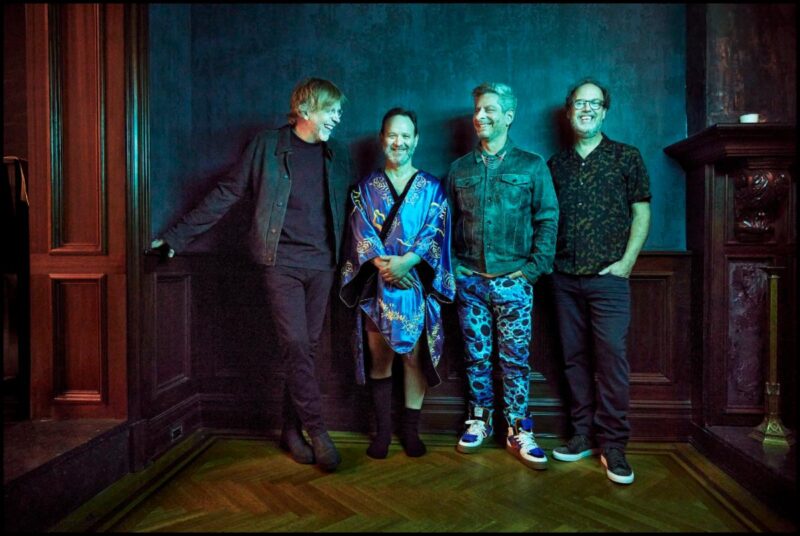
Phish formed at the University of Vermont in 1983. Trey Anastasio on guitar, Mike Gordon on bass, Jon Fishman on drums, and initially Jeff Holdsworth on guitar, who left in 1986. Keyboardist Page McConnell joined in 1985. Those four have been playing together ever since, give or take a hiatus that we’ll get to.
The early band was almost perversely eclectic. Jazz, bluegrass, funk, progressive rock, barbershop vocal harmony, avant-garde composition: all of it showing up in the same set, sometimes in the same song. Their early piece ‘You Enjoy Myself’ is a good example: it moves through composed sections of considerable technical complexity before dissolving into an improvised vocal jam where the four members trade syllables and sounds rather than words. It shouldn’t work. It works completely.
The early chapter of Phish history is the story of a band that built its following the way bands did before social media: by playing constantly, by encouraging tape trading, by treating every show as a distinct event rather than a performance of a set repertoire. The early New England fanbase was intensely loyal because Phish gave them something to be loyal to: the knowledge that last night’s show was different from the night before, and that tomorrow’s would be different still.
The First Albums: Context, Not Canon
Phish’s studio discography is worth knowing, but I want to be honest about its place in the band’s universe. Junta (self-released in 1989 and reissued by Elektra in 1992) is fascinating as a document: it contains early versions of songs that became live staples for decades, including ‘You Enjoy Myself,’ ‘Golgi Apparatus,’ and ‘David Bowie,’ and it shows a band that had already developed a distinctive compositional approach. But the recordings are rough and the arrangements feel compressed compared to what these songs became in performance.
Lawn Boy (1990) and A Picture of Nectar (1992) refined the sound. Rift (1993) is their most conventionally ‘produced’ early album, a loose concept record about dreams with some of their most structured songwriting. Hoist (1994) brought in guest musicians and reached a wider audience. None of these records fully captures what Phish actually is, and I think the band would tell you the same thing. The studio was a place where they worked out ideas that then got taken somewhere else entirely on the road.
The Live Show: What the Records Can’t Tell You
The real Phish archive is the live recordings, and if you want to understand this band, that’s where to go. Archive.org hosts thousands of shows going back to the mid-1980s. Phish.net maintains a show database and jam chart that tracks the best improvisational moments across decades of performances, a remarkable resource built entirely by the fan community.
What makes a great Phish jam? It’s a fair question, and the answer involves patience. These aren’t bands playing extended solos over a chord progression. A Phish jam is a collective improvisation where all four musicians are listening and responding to each other in real time. The best ones build momentum gradually: establishing a groove, then complicating it, then pushing into territory where nobody in the room, including the band, knows exactly what’s going to happen next. A great ‘Tweezer’ or ‘Bathtub Gin’ or ‘Disease’ can run thirty or forty minutes and feel like it lasted ten. A mediocre one can feel interminable at fifteen. The difference is whether the conversation is actually happening or whether they’re just playing loudly.
The mid-1990s produced some of the most celebrated shows in the band’s history. The Halloween shows, where Phish played another band’s album as a “musical costume,” became legendary events. The tradition began in 1994 with the Beatles’ White Album, followed by The Who’s Quadrophenia in 1995, Talking Heads’ Remain in Light in 1996 and the Velvet Underground’s Loaded in 1998. The White Album hits home for me, because it was the basis for one of my first album tribute shows on Psychedelic Time Warp. The 1995 summer and fall tours, in the months after Jerry Garcia’s death brought many former Deadheads into the Phish orbit, are widely considered a peak of the band’s improvisational powers.
The Hiatus, the Return, and the Second Peak of Phish History
Phish announced a hiatus in October 2000. The final show before the break, at Shoreline Amphitheatre in California, was emotional and musically strong. The return, in 2002, was brief and somewhat troubled. In May 2004, Anastasio announced the band was done, and a chaotic, rain-soaked festival at Coventry, Vermont that August served as the farewell.
The reunion in 2009 was welcomed with something approaching relief across the jam community. And the years since have been, by most measures, the second flowering of Phish history. The band has played with consistent focus and musical ambition. Albums like Fuego (2014) have their moments. But more significantly, the live shows have regularly matched and occasionally exceeded the creative heights of the 1990s, a remarkable thing for a band that had been together for thirty-plus years.
Their New Year’s runs at Madison Square Garden have become one of music’s most coveted tickets. The 2024 Sphere residency in Las Vegas took the visual spectacle of a Phish show to a scale that hadn’t been attempted before. They returned to the Sphere in spring 2026, and by all accounts it was extraordinary.
Why the Studio Albums Are the Wrong Starting Point
I want to come back to this, because it shapes everything about how you approach Phish. The studio albums are documents. The live recordings are the music. If you want to understand what all the fuss is about, find a recording of a great show from 1994, or 1997, or 2012, or last summer. Listen to it front to back, the way you’d listen to an album. Pay attention to how the songs change shape, how themes from one piece reappear in another, how the band moves as a unit through music that nobody fully composed.
Phish is a band that rewards investment. The first show you hear might not grab you. The third one probably will. By the tenth, you’ll have opinions about specific years and specific configurations and specific songs. That’s how it works. The community that’s built around this band over forty years of Phish history (the tape traders, the lot scene, the detailed show databases) is a product of that investment paying off. There’s always more to find.