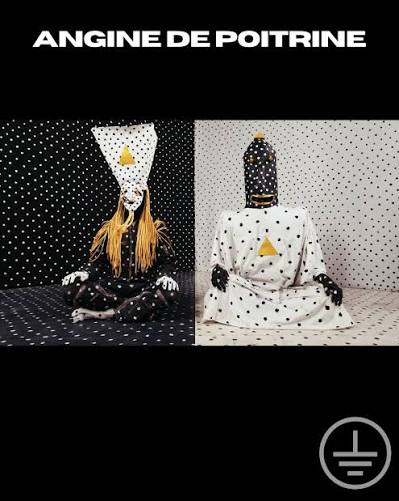
The old guy from the Dos Equis commercials may be the most interesting man in the world, but Canada’s Angine de Poitrine may currently be the most interesting band in the world.
Simply watch Angine de Poitrine perform. Get past the full-body black-and-white polka-dotted suits and oversized papier-mâché masks with enormous noses, and realize they are playing music that is simultaneously too complex to follow and too physical to resist. The drummer locks into a groove that makes you want to move. The guitarist, playing a custom-built double-necked instrument that combines a microtonal guitar and a bass into a single improbable object, makes music in a way that feels like it is coming from a different tuning system entirely, because they are. And somehow, against all logic, it works. It’s a funky, groovy, addictive sound that makes you want to tap your foot along to the rhythm.
The band is from Saguenay, Quebec, and the name translates roughly to angina pectoris, the medical term for chest pain caused by restricted blood flow to the heart. They describe their own sound as “dissonance-induced cardiac malfunction,” which is both a joke and an accurate diagnosis. The two members perform under the pseudonyms Khn de Poitrine and Klek de Poitrine, have been playing music together since they were thirteen years old, and have never publicly revealed their real names. The anonymity is part of the presentation, and the concept started as a prank.
In 2019, the pair were booked to play the same local Saguenay venue twice in one week and were worried that in a small town, the same audience would show up both nights to hear the same set. Their solution was to play the second show in disguise, as a completely different band, with a completely different name. They built the masks themselves, sewed the costumes, and showed up as Angine de Poitrine. The crowd had no idea. They described it at the time as a joke in true Andy Kaufman style. What they did not anticipate was that the joke would become the most serious artistic project of their lives.
They spent the pandemic years working construction jobs, which is the kind of background that makes the story feel even more relatable. When live music came back, they returned to the stage, built a following on the Quebec festival circuit, released their debut album Vol. 1 in June of 2024, and spent 2025 playing Le Festif!, M for Montreal, the Montreal Jazz Festival, and Pop Montreal. In December 2025, they won Artist of the Year at the GAMIQ awards, the most prestigious recognition in Quebec’s independent music community.
Then in February 2026, Seattle radio station KEXP posted a live session the band had recorded at Trans Musicales in Rennes, France. (See YouTube video below). Within a week, it had been viewed more than two million times. As of September 2026, it has surpassed nineteen million views (as of this date of publication) and continues to climb. The internet loved that two masked Canadians playing microtonal math rock in polka-dot suits were exactly what it needed.
The Sound
The first question most people ask when they see Angine de Poitrine for the first time is some version of “how are only two people making that much noise?” It is a fair question, and the answer is worth understanding because it is central to what makes the band so compelling.
Khn de Poitrine’s custom-built double-necked instrument that functions simultaneously as a microtonal guitar and a bass. Microtonal means the instrument is tuned to frequencies that fall in the cracks between the standard notes of Western music, the notes that do not exist on a conventional guitar. King Gizzard has also recorded three albums exploring microtonal music: Flying Microtonal Banana, K.G., and L.W.
The result is a sound that feels slightly off-center in a way that is deeply hypnotic rather than jarring. And then there are the loops. Khn layers phrases in real time, building up dense, interlocking patterns that give the music a richness and depth that you simply would not expect from a single player. By the time a piece is fully underway, what you are hearing sounds less like one guitarist and more like a small ensemble that has been locked in a room together for years and learned to think as one organism.
But the real engine of the band is Klek de Poitrine on drums. This is not background percussion. This is the kind of drumming that stands out right from the first measure and does not let go. There is a foot-stomping, body-moving quality to the rhythm that sits somewhere between math rock precision and genuine funk, which is a combination you do not hear very often and which is almost impossible to fake. The grooves are asymmetrical on paper but feel inevitable in practice, the way the best rhythmic music always does.
Together the two elements create something that should not add up but does. The microtonal guitar loops build a shimmering, slightly alien harmonic world above the rhythm, while the drums anchor everything in something deeply physical and immediate. It is cerebral and visceral at the same time, which is a very difficult thing to pull off and which is probably the single best explanation for why sixteen million people have watched that KEXP video.
The Tour That Nobody Can Get Tickets For
The tour that followed the KEXP moment has been something to behold. The April and May Quebec leg sold out almost entirely before most people outside the province had heard of them. Club Soda in Montreal, Le Pantoum in Quebec City across three consecutive nights, all gone. The UK dates in May at Leeds, London, and Bristol sold out. Rennes, Le Mans, Amiens, Charleroi, and Brussels in Europe sold out. Both nights at Le Poisson Rouge in New York in September, sold out. Three nights at the Mod Club in Toronto in July, all sold out. The Imperial Bell in Quebec City in November sold out. The final Club Soda date in Montreal in November sold out.
That festival run delivered. Winnipeg Folk Festival, Ottawa Bluesfest (where organizers moved them to the main stage over safety concerns), Fuji Rock in Japan (where the field hit capacity and had to turn people away, a first for that stage), Newport Jazz Festival, King Gizzard’s own Field of Vision festival in Colorado (12,000 people, reportedly the most-hyped set of the weekend), and Meo Kalorama in Lisbon all sold out or drew record crowds. Reviewers reached for words like “phenomenon,” and fans described the mosh pits as the hardest they had ever been in.
The tour is not over. They play Washington, DC on September 15 and Philadelphia on September 16, then head to Los Angeles, San Francisco, Portland, and Chicago through November and December. I’m looking forward to catching them at the Salt Shed in Chicago in November. If you are anywhere near one of those dates and tickets are still available, stop reading and go buy them now.
Why We Are Playing Them
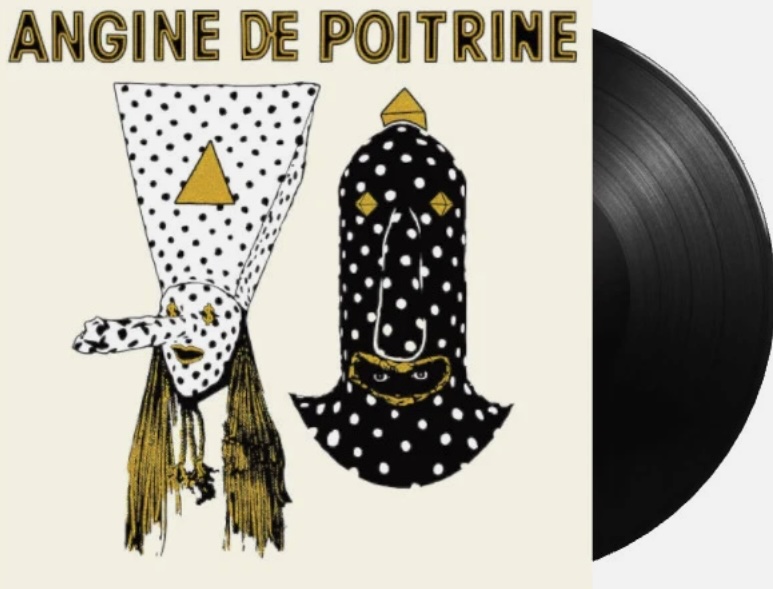
Their second album, Vol. II, released digitally on April 3, 2026 via Spectacles Bonzaï, with ATO Records handling physical distribution in the United States, is the document of a band that has figured out exactly what it is and is no longer interested in making it easier for anyone. It is one of the most original records to come out of Canada in years. We have been playing Angine de Poitrine on Acid Flashback radio, and the response has been great from people who know their music.
This is one of those bands that comes along rarely, the kind where you want to be able to say you were there from the beginning. For American listeners, the beginning is right now.
Angine de Poitrine made their network television debut on the Tonight Show with Jimmy Fallon on September 14, 2026.
Angine de Poitrine official website
Tags: Angine de Poitrine, Quebec Music, Math Rock, Experimental Rock, KEXP, Vol. II, Saguenay, Canadian Music, Microtonal, ATO Records