Most people discover Pink Floyd through Dark Side of the Moon. That’s fine, it’s one of the greatest albums ever made. But Pink Floyd before Dark Side of the Moon is a different band entirely, and if that’s where you started, you’ve missed the best part of the story. The real Pink Floyd (the one that still surprises me after fifty years of listening) lives in the records before 1973. That’s where I want to take you.
I’ll give you my credentials upfront: Pink Floyd is one of my four all-time favorite bands, alongside the Grateful Dead, Peter Gabriel-era Genesis, and King Gizzard & the Lizard Wizard. I contributed a chapter to Stu Shea’s Pink Floyd FAQ, published by Backbeat Books. I’ve programmed their music on Acid Flashback Radio since we launched in 2012, and included them in many episodes of Psychedelic Time Warp. I’ve been inside this music for a long time, and I’m still finding things in it.
Syd Barrett and the Original Vision
Pink Floyd formed in London in 1965: Syd Barrett on guitar and vocals, Roger Waters on bass, Richard Wright on keyboards, Nick Mason on drums. Architecture students and art school kids, all of them steeped in the London underground scene that also produced the early Who, the Pretty Things, and the first stirrings of British psychedelia.
Their reputation grew fast through a residency at the UFO Club, a basement venue on Tottenham Court Road that opened in December 1966 and quickly became ground zero for the London underground scene. Pink Floyd played the club’s opening night and became something close to its house band on Friday nights, sharing the bill with Soft Machine, performing under swirling light shows that were as much a part of the experience as the music. It’s where the band’s reputation as something genuinely new got built, well before most of the country had any idea who they were.
Before the album, there were two singles. “Arnold Layne,” released in March 1967, was produced by Joe Boyd and recorded at Sound Techniques studio in Chelsea. The follow-up, “See Emily Play,” came out that June under the band’s new deal with EMI, produced instead by staff producer Norman Smith. The album itself was recorded at EMI’s Abbey Road Studios in the same building where the Beatles were finishing “Sgt. Pepper’s Lonely Hearts Club Band” down the hall, one of those small coincidences of pop history that’s fun to sit with.
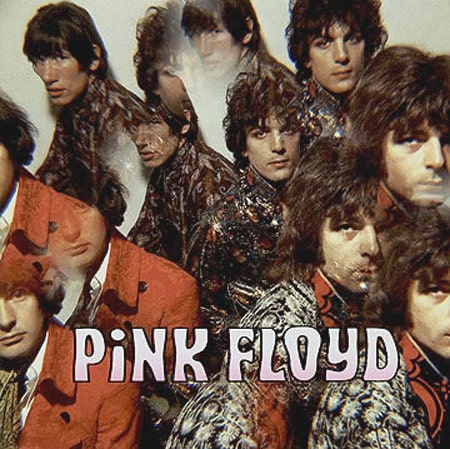
The band’s first album, The Piper at the Gates of Dawn, came out in August 1967 and it remains one of the strangest, most purely imaginative debut records in rock history. Barrett wrote almost all of it, and his frame of reference was genuinely unusual: English children’s literature, science fiction, nursery rhyme cadences twisted into something unsettling. “Interstellar Overdrive” is eleven minutes of free-form improvisation that sounds like nothing else from that year. “Astronomy Domine” opens the record with voices listing planetary names over a churning, slightly menacing groove. “Chapter 24” is based on the I Ching. This was not pop music dressed up in paisley. This was something else entirely.
The deep cuts on Piper are where Barrett’s genius really lives. “Flaming” and “Bike” are whimsical to the point of surrealism: “Bike” ends with a room full of musical toys playing themselves into chaos. “Matilda Mother” is a minor-key fairy tale. If you’ve only heard the Floyd radio staples, sitting with Piper front to back is a genuinely disorienting and wonderful experience.
A Saucerful of Secrets and the Transition
Barrett’s mental health deteriorated rapidly through 1967 and into 1968, the casualties of heavy LSD use compounded by what appears to have been an underlying vulnerability that would have surfaced regardless. David Gilmour joined as a second guitarist, then effectively replaced Barrett, who was quietly phased out of the band by early 1968.
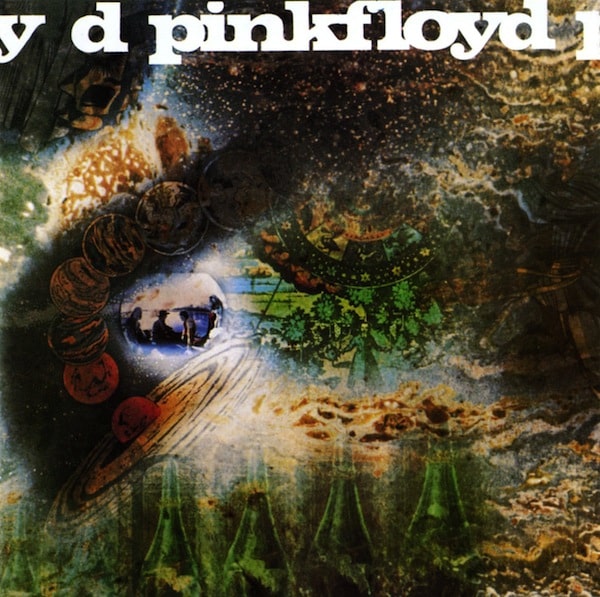
A Saucerful of Secrets (1968) documents the transition. Barrett contributes one song: “Jugband Blues,” which is either a masterpiece or a breakdown or both, a song that ends with a Salvation Army band playing random notes while Barrett asks “what exactly is a joke?” The rest of the album is the remaining four members figuring out who they are without their primary songwriter. The title track is a twelve-minute instrumental in four movements that sounds nothing like anything they’d done before: abstract, spacious, genuinely experimental. Roger Waters wrote “Set the Controls for the Heart of the Sun,” which became a live staple for years, a hypnotic, eastern-influenced piece that rewards long and patient listening.
Most Floyd retrospectives treat Saucerful as a transitional curio. I’d argue it’s essential. You hear the band inventing their second identity in real time.
The Overlooked Middle Period: More Through Meddle
The albums from 1969 to 1971 are the most underrated stretch of the Pink Floyd catalog, and they’re where I spend a lot of my time on Acid Flashback Radio. More (1969) is a film soundtrack, loose and varied, it contains “Cymbaline,” one of the great atmospheric tracks in their entire catalog, and “Green Is the Colour,” a delicate acoustic piece that most fans have never heard. Ummagumma (1969) is a double album, half live recordings and half solo experiments by each band member. The live disc (featuring extended versions of “Astronomy Domine,” “Careful with That Axe, Eugene,” and “Set the Controls”) is indispensable. The studio disc is challenging, occasionally maddening, and fascinating throughout.
Worth a mention here too: the band also contributed music to Zabriskie Point (1970), Michelangelo Antonioni’s film about the American counterculture. It came out as a various-artists soundtrack rather than a proper Floyd album, and it holds three of their tracks: “Heart Beat, Pig Meat,” “Crumbling Land,” and “Come In Number 51, Your Time Is Up” (a rerecorded version of “Careful with That Axe, Eugene”). What is more interesting is what got left off. A piece called “The Violent Sequence,” recorded for the film and never used, was reworked a few years later into “Us and Them.” Dark Side of the Moon is already taking shape here, three years before anyone knew it.
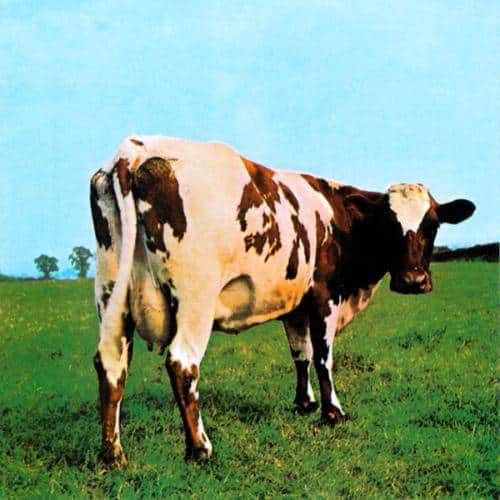
Atom Heart Mother (1970) opens with a twenty-three-minute suite for rock band and orchestra that is either Pink Floyd’s most ambitious work or their most indulgent, depending on your tolerance for French horns. I’m firmly in the ambitious camp. The second side is four shorter pieces, including “If,” a Roger Waters acoustic ballad of quiet devastation, and “Alan’s Psychedelic Breakfast,” which is exactly what it sounds like. None of this sounds like Dark Side. All of it sounds like a band that has no interest whatsoever in playing it safe.
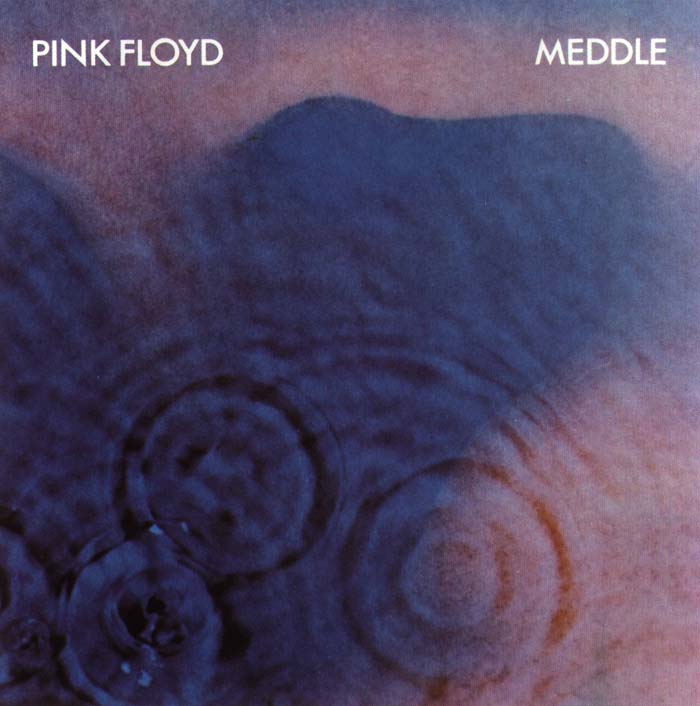
Meddle (1971) is where the pre-Dark Side Floyd peaks. “Echoes,” the twenty-three-minute side-long suite that closes the record, is the piece I’d point to if someone asked me what Pink Floyd was actually about. It builds from a single piano note (amplified into a sonar ping) through passages of genuine beauty, a middle section of abstract noise and seagull-like guitar squalls, and then back up into one of the most satisfying resolutions in progressive rock. The rest of the album is excellent too: “One of These Days,” “A Pillow of Winds,” “Fearless” with its West Ham United crowd recording. Meddle is the album that made Dark Side inevitable and makes everything after it make sense.
Obscured by Clouds and the Bridge
Obscured by Clouds (1972) is another film soundtrack, made quickly and cheaply, and it gets dismissed as minor Floyd. That’s too harsh. “Wot’s… Uh the Deal” is one of Roger Waters’ most affecting songs, a meditation on missed opportunities and the passage of time that hits differently the older you get. “Free Four” is sardonic and rhythmically propulsive. “Childhood’s End” is a full-band rocker that could have fit on any of the next three records. Worth the time.
Dark Side, Wish You Were Here, and the Shadow of Syd
Dark Side of the Moon arrived in March 1973 and changed everything. I’m not going to say much about it here because everybody already knows it exists, though I’ll note that the deep cut on that album is “Any Colour You Like,” the instrumental that gets skipped by people in a hurry to get to “Brain Damage.” Don’t skip it.
Wish You Were Here (1975) is the album where the Floyd’s emotional life becomes most transparent. It’s a tribute to Syd Barrett: “Shine On You Crazy Diamond” Parts I-V open the record and Parts VI-IX close it, bookending the album’s two non-Barrett songs like a frame around a wound.
What most people don’t know: Barrett actually showed up at the Abbey Road sessions during the recording of Shine On, unrecognized initially by his former bandmates because his appearance had changed so dramatically. Gilmour recognized him eventually. The coincidence (if it was one) is almost too much to process. “Welcome to the Machine” and “Have a Cigar” are the record’s bitterest songs, Waters’ indictment of the music industry delivered with real fury. The album as a whole is more cohesive than Dark Side and, in my view, more emotionally honest.
After The Wall: A Different Band
Animals (1977) and The Wall (1979) are excellent records, Animals especially, which is the most politically ferocious thing they ever made. But by then the band was fracturing, and Roger Waters was becoming the dominant creative force in ways that eventually proved unsustainable. He declared the band finished in 1985. Gilmour and Mason disagreed, kept the name, and continued.
The post-Waters albums, A Momentary Lapse of Reason (1987) and The Division Bell (1994), have their defenders and I’m partial to some of Division Bell‘s longer pieces, particularly “Marooned,” an instrumental that gives Gilmour room to do what he does better than anyone.
Keyboardist Richard Wright died of cancer on September 15, 2008. His playing was quieter than Waters’ bass or Gilmour’s guitar, but it was the glue that held the Pink Floyd sound together, and Nick Mason has said as much himself. In 2014, Gilmour and Mason returned one more time with The Endless River, a mostly instrumental album built from ambient material recorded during the Division Bell sessions and dedicated to Wright’s memory. It turned out to be the band’s actual final album. Gilmour said touring behind it was impossible without Wright, and that, more than any falling out, is what really ended Pink Floyd.
Pink Floyd Before Dark Side of the Moon: Where to Start
If you only take one recommendation from this piece, make it this: Pink Floyd before Dark Side of the Moon starts with The Piper at the Gates of Dawn. From there, work forward through A Saucerful of Secrets and Meddle. The band’s full history makes clear that the sound most people associate with Pink Floyd was built on everything that came before it.
But if you’re listening to Pink Floyd for the first time, start at the beginning. Work forward slowly. The map of this band’s music rewards patience and repays repeated visits. There’s always something new in it.