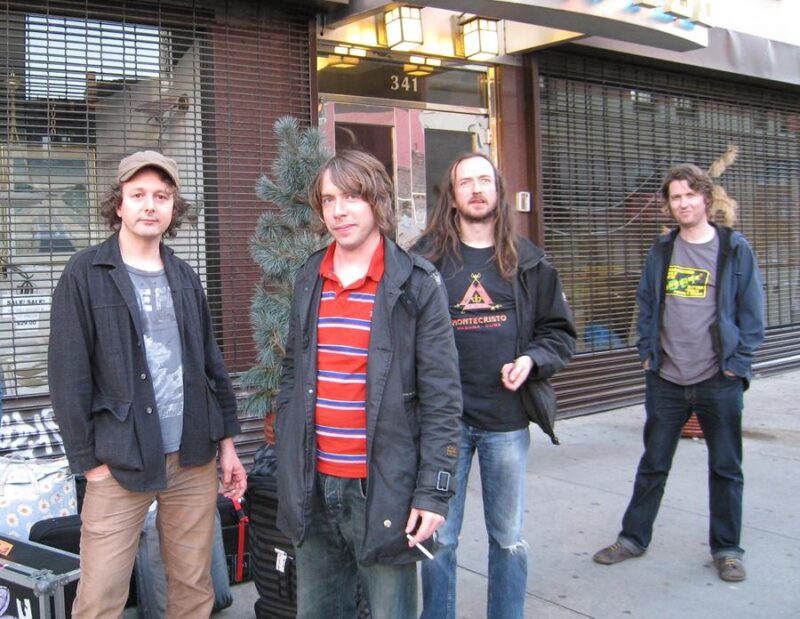
In this Chapterhouse interview, Andy Sherriff of Chapterhouse looks back on Whirlpool, Pearl, and the band’s 35th anniversary tour. Chapterhouse is a British shoegaze band that formed in Reading, England, in 1987. Founders Andy Sherriff, Stephen Patman, and Simon Rowe grew up together before completing their lineup with Russell Barrett and Ashley Bates. Taken under the wing of Spacemen 3, who name-checked them in the press and invited them on tour, the band spent three years gigging across London alongside contemporaries Lush, Slowdive, and a young Blur. Their debut album, Whirlpool, was released in 1991 on the Dedicated label and became a defining record of the shoegaze era, with the single “Pearl” delivering their commercial breakthrough. A second album, Blood Music, followed in 1993, but mounting label pressure to recreate “Pearl” wore on the band’s creative spirit, and Chapterhouse went quiet. A brief reunion in 2010 touched down in Japan and the United States. Now, thirty-five years after Whirlpool, they are back on the road with a world tour.
On the road this year, Chapterhouse is founders Andy Sherriff and Stephen Patman on guitars and vocals and Ashley Bates on drums, joined by Greg Moore on bass and Joe Light on guitar. Light is filling in for founding guitarist Simon Rowe, who is sitting out this run.
When I received an email from the band’s publicist, curiosity got the better of me. I had not heard of Chapterhouse, but I was certainly familiar with their counterparts in the shoegaze world. Bands like Jesus and Mary Chain, The Verve, Cocteau Twins, Catherine Wheel, and Lush. I loaded Spotify and began listening to Whirlpool, and songs like “Breather,” “Guilt,” and “Treasure” made me an instant fan. I readily agreed to interview Andy Sherriff about the band, the album, and the tour in support of Whirlpool‘s 35th anniversary. It turned out to be one of the more enjoyable conversations I’ve had in a while.
Editor’s note: We spoke in early May, just before the band’s North American dates, which included the Slide Away festival shows in Brooklyn, Chicago, and Los Angeles. Those shows have now taken place. At last check, the tour continues with shows in South America this month, Butlin’s Minehead on November 13 to 15, Belfast on November 20, and Dublin on November 21, with a Tokyo date set for February 17, 2027. Visit the band’s website for the latest dates.
A Band Born in a Video Shop
Steve Leventhal
How did you guys start the band?
Andy Sherriff
So we all sort of grew up together, me, Stephen, and Simon, but me and Simon mostly. But then, we went to secondary school with Stephen, who was in my class there. But I left and lived in Saudi Arabia for a couple of years, but had to come back because my school closed down in Saudi Arabia, so I met Stephen in a video shop, the old school Blockbuster type, and he said, “Oh, I was talking to Simon about forming a band. Would you like to join as well?” I was, “yeah, yeah, definitely.” So the whole way that the band formed seemed quite organic, really.
Steve Leventhal
And how did you get your musical training? Did you have some natural skills that just blossomed?
Three Guitarists Who Didn’t Want to Sing
Andy Sherriff
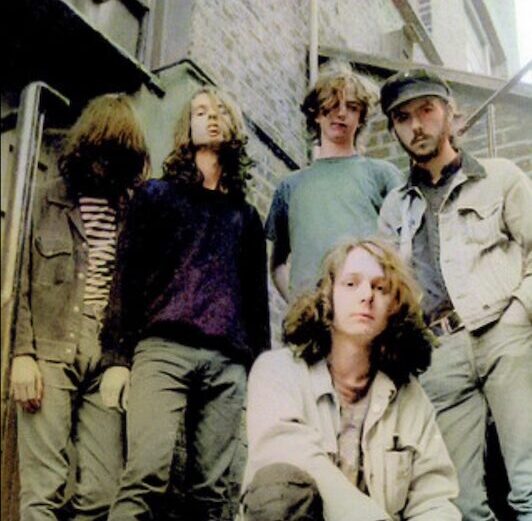
All three of us played guitars. So that was the difficulty with the band to start off with, that there were three guitarists. And none of us really wanted to sing. But in the end me and Stephen decided we would take it in turns to sing different tracks. And I guess that is part of the reason that the band ended up sounding like it did. We had that extra guitar. If I was doing vocals, I wouldn’t always play it, but then come in for the heavy bits and so on. In a way that originally it sounded like it was a hindrance, but it actually came to be a positive.
The Sounds That Shaped Chapterhouse
Steve Leventhal
Who are some of these bands that really influenced you, that in a way made you say, “Hey, I can do this”?
Andy Sherriff
Yeah, well, there was a great scene of indie bands in the late eighties, from the Cocteau Twins to Echo and the Bunnymen. Jesus and Mary Chain were particularly a big influence. And we would go and see bands like Primal Scream when they were quite small. I remember going to see them at a place in London called Club Foot, and you’d get to see four bands for £3.50, which is unthinkable now. So those bands inspired us, but we were also more inspired by sixties music, really. That was our big thing. Lots and lots of sixties music, from obviously the Beatles and the Kinks to the Byrds to the Stooges, and Velvet Underground. A lot of psychedelic sixties stuff as well, “Pebbles” bands. [That refers to the underground garage rock and psychedelic groups of the 1960s. They are named after Pebbles, a famous series of vinyl compilations that rescued these obscure, raw, and independent regional bands from obscurity.]
Steve Leventhal
(points to a Saucerful of Secrets t-shirt he’s wearing)
Andy Sherriff
Pink Floyd, yeah, there you go. Definitely the Syd Barrett Floyd as well. When we first started, we just went into a rehearsal room and decided that we would choose a load of cover versions to cement our sound, see where our sound was going, and what we were about. And so yeah, we just started playing Stooges and the Pebbles stuff, like “Don’t Tread on Me.” I don’t know if you know that track. [It was originally written and recorded by the American garage rock band Kit and the Outlaws. The Dallas-based group released the track in 1966 as the B-side to their single “Midnight Hour.”]
From that, we got asked to play a show, and we thought, “Oh, we’d better write our own music now for this,” and started writing our own tracks. Yeah. So it did kind of come naturally.
Steve Leventhal
When I was perusing Chapterhouse on Spotify, I came across “Lady Godiva” by Velvet Underground, who’s one of my favorite bands. I’m like, okay, I know these guys are good.
Andy Sherriff
Yeah, yeah. The Velvet Underground were, for us, the sort of original alternative band, I suppose, in a lot of ways, or deliberately alternative. You could argue that the Stooges were as well, I suppose.
Steve Leventhal
Oh absolutely.
Andy Sherriff
Yeah. The Velvet Underground were basically one of those bands that open your eyes, I think, to a whole different world.
Steve Leventhal
Right, because it’s just the way they take the music, embrace the music, but then it just goes in so many different directions and just all the different songs, whether it’s “Heroin” or “Sweet Jane,” such an interesting combination. I love any band where you’ve got multiple writers. That’s why I always say, unfortunately, for better or for worse, every Coldplay song sounds like every other Coldplay song.
Andy Sherriff
So yeah, on Velvet Underground, as you say, you can have “Sunday Morning” and then “Venus in Furs.” It’s like two opposite ends of the spectrum, but they’ve always worked so well together. It seems so natural. And also, I suppose it was music as an art form, and that whole Exploding Plastic Inevitable thing that Andy Warhol put together was just about as much about visuals, lights, dances, as the music itself. You know, they were part of that cog, I guess.
Steve Leventhal
Then, of course, David Bowie, who took it to the next level.
Andy Sherriff
Yeah, yeah.
Steve Leventhal
What about Genesis? Do they have any influence on you guys?
Andy Sherriff
Not really. We were much more influenced by slightly earlier bands than Genesis. I mean, I have a lot of time for them, but we didn’t really get into them, or they weren’t an influence on us, per se.
Steve Leventhal
You mentioned Echo and the Bunnymen a lot. I love to introduce them as “the second best band to ever come out of Liverpool.”
Andy Sherriff
I think Ian McCulloch would disagree with you, because he thinks that they’re the best band ever.
Spacemen 3 and Coming Up in London
Steve Leventhal
Okay, so let’s talk about Spacemen 3. They took you guys kind of under their wing. What was it? They mentored you? How did that relationship work?
Andy Sherriff
So I told you that we got asked to do that first show. Just as we were rehearsing, someone pushed the door open and said, “Oh, do you want to do a show at this pub?” So we ended up doing two shows at that pub, and then we moved on to a bigger venue. It was the fourth show we did with Spacemen 3. And they name-checked us in the press. We got in touch with them, and they said, “Oh, do you want to come on tour with us?” And we were, “yeah, yeah, we’d love to go on tour with you.” So we bought a cheap old van. I suppose the equivalent of what in the States, a Chevy van kind of thing. We had an Orange Bedford van of that era, and we drove around the country supporting Spacemen, which was great because we loved their music. We were probably more psychedelic rock at that point than comes across on the album, but there are still elements of that left in the album.
Steve Leventhal
So at what point did you decide, okay, we really need to relocate to London?
Andy Sherriff
I think we were always going to move to London. Actually, I was at university in London. We started the band the year after we left school, and we were just 18. Then I went to university in London, and everyone else followed me. Stephen and Simon lived in a squat in Notting Hill. That’s unusual. It was a massive house. But back then, squatting was more common in London. It was easier to do. But now it’s almost impossible, because everywhere’s gentrified, particularly Notting Hill.
Steve Leventhal
So then what was the scene like, and what year was that?
Andy Sherriff
That was probably eighty-eight, because that’s when I went to university. And so we probably spent three years, ’cause yeah, all the years I was at university, I was at UCL [University College London], just gigging in Camden Town, gigging in Fulham, gigging in little places. We would go back to Reading and Oxford and play there. That was our sort of apprenticeship, I think in a way. And during that time we had lots of interest from different labels, but we didn’t know which one to sign with, and in the end we ended up signing to Dedicated because they were the most keen. We almost signed to Fire Records, which was Spacemen 3’s label at the time. It wasn’t their own label. It was the label they were signed to.
It was a fun time, though, because there were a lot of other bands like Lush and Slowdive, and all of them were gigging at the same time. They would come up to London. Well, Lush were already in London, but Slowdive would come up to London from Reading, and we’d play at the Camden Falcon and so on. So, although it wasn’t really a scene, or we didn’t acknowledge it as a scene at the time, I suppose it was. We would play gigs together, but then we would hang out with Blur as well, and we did one of our first London shows supporting Blur here in the venue in New Cross.
Andy Sherriff of Chapterhouse on Making Whirlpool
Steve Leventhal
Let’s talk about the first album, Whirlpool, and the song “Pearl,” which I guess was your first single.
Andy Sherriff
That was actually the third single, but that’s the one that’s most well known, definitely, and it was the most important single off Whirlpool, yeah. It’s got more of a pop sensibility, I suppose, than some of the other tracks.
Steve Leventhal
Well, that’s probably what helped it do well, yeah, because I really like the first song from your album.
Andy Sherriff
“Breather.”
Steve Leventhal
Yeah. That fits more of the bill, and it’s probably more descriptive of what you got there. So tell me about just putting the album together and recording it, and the process of what happened.
Andy Sherriff
So it was recorded over quite a long period of time because, like I said, we were gigging for those three years between eighty-eight and ninety-one. We would go up to Rugby and record at the same studio that Spacemen 3 used to use, VHF Studio. And that gave us a bit of time to develop our sounds and record things. Then, once we signed the record deal, we took those tracks to bigger studios to mix the tracks and add different things to them. So I think that’s why there’s quite a variety of styles on the album. But like you say, “Breather,” the first track, that’s probably one of my favorites. That was the sort of track that’s just completely live, recorded in a couple of takes, and has that energy to it, which is great. I suppose that bands like Dinosaur Jr. and Bob Mould were influences for that sort of sound.
Blood Music and the Label Problem
Steve Leventhal
Absolutely. So the second album is Blood Music. A little different. You got more into electronic and dance, from what I read.
Andy Sherriff
Yeah, there were electronic and dance elements on the first album, “Falling Down” and “Pearl” in particular. So I kind of carried those on a bit more into this, the second album. But I was talking to someone about this the other day, and I think we’ve always been a band that likes to experiment with sound. We’ve actually got three sound engineers in the band, and I’m now a professional sound designer as well. So we always had that interest, and I think we just wanted to experiment with stuff that we didn’t really completely understand. That’s the fun bit, isn’t it?
Steve Leventhal
Oh absolutely.
Andy Sherriff
You read biographies of what they were doing in the sixties and really pushing the boundaries of recording techniques, and I found that very interesting. So we were always trying to do that sort of stuff, like flipping the tape over so that it went backwards and recording the reverb so that you could then, when you flipped it back over, you had a reverse reverb or recording a solo so that it’s all reverse as well, you know, that kind of stuff, using speakers as microphones and or having mics in odd places around the room that you wouldn’t normally expect. So yeah, we were always playing with recording techniques. I suppose with Blood Music we pushed the dance and electronics side a bit more and Stephen got more into his sort of rock phase then as well. So it’s got a lot of tracks that are more rocky, I think, as well. But I suppose the only thing that’s not is that it’s not as cohesive, I think, a record, but it’s more experimental, more of a studio album maybe.
Steve Leventhal
I’ve often asked artists, you know, what could they have possibly done if they had today’s technology back in the sixties with all the digital recording and the multi-track, where they’re taking tapes and recording tapes on top of tapes and overdubs, which, as you know now, it’s all digital, and you can just move things around so easily.
Andy Sherriff
I kind of pine a little bit for the days when it was a bit harder in a way, and you had to go into these studios, and you would have a limited amount of time to record stuff. So, back in the early sixties, they were recording a whole album in a day. I think that was probably a bit much. But I think towards the end of the sixties, this is what Brian Wilson was doing in the studio, which was just exceptional. I mean that album Pet Sounds is one of my favorite albums as well.
Steve Leventhal
Almost every artist I talk to just says how big that is, and of course, Paul McCartney talks about how the album made him up his game and led to Sgt. Pepper. So there’s no question that’s such an incredible album. And yeah, I’ve seen the footage, and I’ve seen the movie where they recreate that, and just trying to imagine what’s going on in his head. I mean, he’s listening to all the music in his head, right? Like Beethoven or somebody.
Andy Sherriff
Yeah. Oh yeah, I mean, he’s up there with those guys, I believe, on some of the tracks on that album. And being a producer, when you listen to the album, you think, “Oh my god, how did they come up with that sound?” It’s incredible.
Steve Leventhal
Oh yeah, and then right, you had to work harder, rehearse better, and make fewer mistakes because you were just limited, like you said, in the amount of time you could spend. And you don’t want to accidentally overwrite something, as it’s gone forever.
Andy Sherriff
Oh god, yeah. And that must have happened to everyone at some point.
Life After the Band
Steve Leventhal
So you only had two albums. What happened to the band? Why didn’t it keep going and become as well known, although I don’t want to say you’re not well known, but as some of these other bands that we talk about?
Andy Sherriff
I think partly because we signed to a major record company, and not an indie label. There was a bit of extra pressure that was put on us after the first album. Particularly because “Pearl” kind of happened. That was the last track that I wrote for Whirlpool. And it was only supposed to go on there as a sort of little track at the end. Oh, here we go. Here’s a nice little track, kind of to give away with the album. But in the end, once the record company had heard that, their ideas changed a lot, and they basically wanted us to rewrite “Pearl,” and that became a bit of a chain around our necks, really, because as an artist you can’t just sit down and deliberately copy something that you’ve written yourself. It makes the whole creative process a bit tedious.
Steve Leventhal
So what’s that expression, “you’ve got your whole lifetime to write your first album, and six months to come up with the second”?
Andy Sherriff
Exactly. So we did write a lot of material between the two albums, but the record company rejected it. You can hear that now. We released a box set called Chronology last year, and we put all that material in between the two albums in the box set because we basically put everything in a timeline of when we recorded it. Some of those tracks are great. They didn’t have the commercial single that they wanted, so they kept on saying to us, “Oh no, you have to keep on trying to come up with a single.” They wanted a single that would be on MTV, on commercial alternative. That’s what they really wanted, and they weren’t gonna take anything else. So in the end, we got fed up.
Steve Leventhal
But now you reunited.
Andy Sherriff
In 2010, we did do a little tour. One in Japan and one in the States.
Steve Leventhal
And so do we get from 2010 to today? Or is it just because of the anniversary of the album?
Andy Sherriff
It’s partly because of the anniversary of the album. 2010 was a bit of fun, but we all had jobs in the music industry and in the sound industry, which we still have, but it’s not as busy as it used to be for some reason. I mean, everyone who’s freelance in the media industry is complaining that there’s not so much work around, etc, etc. Whether that’s because content is shifting because of streaming. Adverts have changed a lot. You’ve got AI as well, and library music, who knows? But anyway, we thought now would be a good time to actually reform and tour the world a bit more properly.
Steve Leventhal
So what are some of the other things that you’ve done along the way here? Your side gigs, as they say.
Andy Sherriff
Ashley, Stephen, and I all worked for the same music production company in London. And so we would create music and sound design for TV, adverts, media, and film. So I guess the biggest thing that I did was all the sound effects for a BBC series called Walking with Dinosaurs. So that’s a really bizarre kind of sideline making dinosaur sounds and so on, but it was good fun.
Back on the Road: The 35th Anniversary Tour
Steve Leventhal
So whose idea was it to redo the album on the thirty-fifth anniversary and then make a big deal out of this? Was it a consensus?
Andy Sherriff
It was a bit of a consensus, but as you probably know, we’re coming to the States to play in a week or so. And six of those dates are at the Slide Away festivals in New York, Chicago, and LA. We got asked by Slide Away to do those six shows. So that made us think, oh, we could just come over, do those six shows, and then fit in some others around those shows, and that’s a viable tour. Whereas before, we would have had to organize the whole thing ourselves and so on and so forth. So we’ve organized half of it, and it’s still quite a lot of work, actually. So it just seemed like the right time to do it. And then once people found out we were doing a short tour in the US, we got asked to do a London show, which we played last week. It was great, yeah. We just did a little tour of the UK, and every day it sold out, so that was really nice.
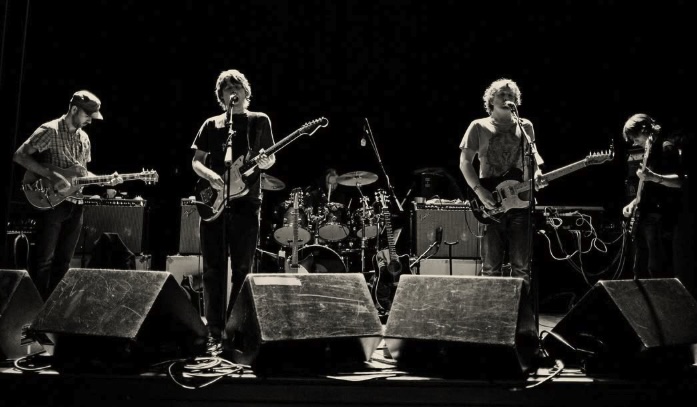
And I kind of recognized that it was the thirty-fifth anniversary of Whirlpool and said to Stephen and Ashley, “Should we just play the album from beginning to end? And then do a second set with some of our favourite B-sides and so on from that era, and a couple of tracks from Blood Music?” And so it’s sort of captured people’s imagination a bit more, I think, to hear the album from start to finish. And it’s yeah, it’s fun to play, and also it’s meant that we’ve played tracks that were on Whirlpool that we hadn’t played for 35 years plus. And those tracks have been fun to pick up again. There’s a track, “Guilt,” which is more of a noise track, and it has a wig-out bit at the end. We just play that until Ashley basically gets tired. Till he gets too tired to carry on. So it’s a bit of a challenge physically for him, but he got called the octopus the other day, so I think that was a compliment.
Steve Leventhal
And how was it rehearsing to do, like you said, songs that you haven’t played in a very long time, or maybe never played live?
Andy Sherriff
It was good fun, actually, because we hadn’t played together for a while. We didn’t know quite how it was gonna go. And I live in Cornwall, which is right down at the bottom of the UK. If you see the UK as a boot, I live where the big toe is sticking out.
Steve Leventhal
Near Wales?
Andy Sherriff
It’s sort of south of Wales. Then, a couple of the guys still live in London, so we met halfway in Somerset in the countryside and hired a residential recording studio, but they had a big live room that we could rehearse in. And so we did four weekends there, which was great ’cause we could sleep there and then get up and rehearse and then go to the pub in the evening for food, come back and rehearse after a couple of pints.
Steve Leventhal
How were the before and after performances?
Andy Sherriff
Well, I think we always thought that the after sounded better, but you would do, wouldn’t you?
Steve Leventhal
Well, the proof would be in the recording. Is there anything else that you’d like to mention?
Andy Sherriff
I mean, the only thing really is to say, “Come and see us play.”
Links
Chapterhouse on Instagram | Official website | Slide Away festival
Chapterhouse FAQ
What is Chapterhouse?
Chapterhouse is a British shoegaze band formed in Reading, England in 1987. Known for layered guitars, dreamy vocals, and a sound rooted in 1960s psychedelia and the British indie scene of the late 1980s, they are best known for their debut album Whirlpool (1991).
What genre is Chapterhouse?
Chapterhouse is primarily a shoegaze band, a genre defined by heavily distorted guitars, ethereal vocals, and dense sonic textures. Their influences include psychedelic rock, the Velvet Underground, and the late 1980s British indie scene, with electronic and dance elements added along the way.
What is the album Whirlpool?
Whirlpool is the 1991 debut album by Chapterhouse, released on the Dedicated label. It is considered one of the defining records of the shoegaze era. The album’s best-known single, “Pearl,” gave the band their commercial breakthrough.
Who is Andy Sherriff?
Andy Sherriff is a founding member of Chapterhouse, contributing guitars and vocals. He has also worked as a professional sound designer, including creating the sound effects for the BBC series Walking with Dinosaurs.
Why did Chapterhouse stop making records?
After signing to a major label following Whirlpool, the band faced mounting pressure to recreate the commercial success of “Pearl.” Unable to satisfy label demands for a follow-up single, they grew frustrated and went quiet after their second album, Blood Music (1993).
Is Chapterhouse touring in 2026?
Yes. Chapterhouse reunited for the Whirlpool 35th anniversary tour, which began in the UK this spring and brought the band to North America in May, including Slide Away festival dates in Brooklyn, Chicago, and Los Angeles. Andy Sherriff said the UK shows sold out. Check the band’s website for upcoming dates.
What is the setlist for Chapterhouse’s anniversary tour?
On the 35th anniversary tour, Chapterhouse performs Whirlpool in its entirety from start to finish, followed by a second set featuring B-sides from the era and select tracks from Blood Music.
Where can I listen to Chapterhouse?
Chapterhouse’s music, including Whirlpool and Blood Music, is available on Spotify, Apple Music, and other major streaming platforms. A box set titled Chronology was also released, featuring previously unreleased material recorded between the two studio albums.
More conversations with the artists: browse all InternetFM Rock Legends interviews.
Chapterhouse, Andy Sherriff, Whirlpool, shoegaze, Slide Away, Spacemen 3, interview